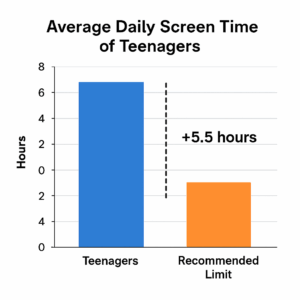
If a friend pulled me aside right now and asked whether all this screen time is doing something to their teenager’s head, I’d tell them plainly: yes, it’s shaping things, and the research backing that up keeps growing. Screens aren’t a side detail in adolescent life anymore — phones, tablets, and laptops are woven into nearly every hour of the day. There’s real value in that connectivity and access to learning, but an expanding stack of research is sounding a note of caution. Scientists are zeroing in on what heavy screen exposure does to the still-forming teenage brain. That brain isn’t a finished product — it’s actively being built. Which is exactly why paying attention to how technology influences its wiring matters so much for raising a mentally healthy generation.
When Willpower Isn’t Enough: The Tool That Actually Interrupts the Reach-for-Phone Reflex
A teenager’s reward system isn’t finished being built, so the tug toward quick digital hits is genuinely tougher to resist on a neurological level than most of us give credit for. Because the prefrontal cortex is still maturing, willpower alone often isn’t enough — sometimes it’s outside structure, not sheer determination, that supplies the friction needed to interrupt a habit loop.
Where this helps
- Builds an actual physical obstacle rather than leaning on willpower alone — the device simply isn’t reachable until the timer runs out, which takes moment-to-moment decision fatigue off the table.
- Offers households a tangible way to set screen limits that doesn’t read as pure punishment; the box takes the blame instead of the parent, which can ease conflict in homes where screen-time negotiations have turned into a daily standoff.
- Supports the wiring of delayed gratification during a window when that skill is still being hardwired — using a tool like this consistently can help the brain strengthen its own impulse-control abilities over time.
Where this falls short
- Falls apart if a teen pushes back hard or experiences it as punishment rather than support; in homes where screen conflict has already turned adversarial, adding a lock box can deepen trust problems rather than ease them.
- Doesn’t touch whatever anxiety, boredom, or social craving is fueling the excessive use to begin with — it sets a boundary, but it’s no substitute for helping a teen find other outlets for connection and stimulation.
I sometimes worry that recommending a lock box can feel like I’m endorsing a “technological fix” to what’s often a relational or emotional problem—and that concern is valid. But in my experience, when a teen is genuinely ready to change and their family is on board, this removes enough friction from the equation that real change becomes possible. If this resonates with your situation, you can find a Mindsight Timed Lock Box here.
About This Article

Written by Sarah Mitchell. Sarah Mitchell isn't a therapist. She got interested in how the mind works after her own struggle with anxiety in her twenties, and has spent 16 years since then reading and personally testing cognitive behavioural therapy (CBT), acceptance and commitment therapy (ACT), and attachment-based approaches. Her writing combines that research with genuine compassion for how hard mental health struggles actually are. More about this site.
Scope and limits. Sarah is not a licensed therapist or clinician, and nothing here is a substitute for care. If you are in crisis or thinking about harming yourself, call or text 988 in the US to reach the Suicide & Crisis Lifeline.
Verify this against a primary source
Specifics change, and your situation may differ from the one described here. These are the authorities worth checking directly:
- NIMH — mental health research and condition information
- SAMHSA — treatment locator and the 988 Suicide & Crisis Lifeline
- American Psychological Association — evidence-based practice guidance