There’s a charging basket by my front door that fills up with three or four phones every evening, tablets included. Screens are woven into how today’s teenagers do everything—finishing assignments, keeping up with friends, unwinding after a long day. That constant plugged-in reality is exactly why so many parents keep circling back to one question: at what point does screen time cross from fine into too much? There’s no clean, universal answer here. Still, getting a handle on what heavy use can do—and picking up a few workable strategies—can help a household land somewhere balanced.
Understanding the Research on Teen Screen Time
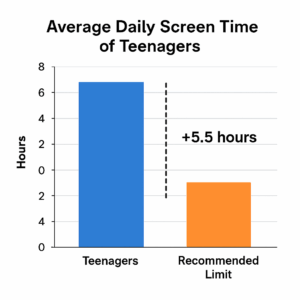
A number of health authorities recommend setting steady caps on recreational screen use for teenagers, even if the specific numbers differ from group to group. What matters more than the raw hour count is what gets pushed aside to make room for it. Once screen time starts eating into sleep, movement, in-person friendships, and hobbies away from a device, that’s usually when trouble becomes noticeable—far more than when device use simply sits inside a well-rounded daily rhythm.
Studies tie heavy device use to disrupted sleep, especially when screens get used right before bed—blue light and mental stimulation both play a part in that. Spending a lot of time on social media has also been connected to higher anxiety and more social comparison in teens, although untangling cause from effect isn’t simple. None of this makes screens the enemy, though—they’re genuinely necessary for schoolwork, creative pursuits, and connecting with others online in ways that matter. The real question isn’t whether teens should be on devices at all, but whether that use is deliberate or driven by compulsion.
Warning Signs That Screen Use Has Tipped Into Trouble
Instead of zeroing in on a magic hour count, pay attention to behavior patterns that hint screen use is drifting into unhealthy territory:
- Noticeable sleep loss, or keeping the phone close enough at night that middle-of-the-night checking becomes a habit
- Pulling away from in-person friendships, sports, or hobbies that used to matter to them
- Visible anxiety, irritability, or shifts in mood whenever the device isn’t within reach
- Grades slipping or homework left unfinished because of distraction or staying up late online
- Physical complaints—eye strain, headaches, slouched posture—turning into a regular occurrence
- Being less than truthful about how much time is really going into being online
These patterns tell you more than any clock ever will. A teenager who games for three hours yet sleeps fine, keeps up friendships, and stays on top of responsibilities is in a completely different spot than one who spends two hours on social media at the cost of sleep and grades.
When Self-Control Falls Short: Why a Physical Boundary Works Better
I’ve watched families set screen time rules that sound perfectly sensible on paper, only to see them collapse in real life—particularly on stressful evenings or when homework is supposed to be happening. Usually the issue isn’t a lack of discipline in the teen; it’s that smartphones are built, by design, to be nearly impossible to resist, and willpower rarely holds up against that kind of engineering. Sometimes the smarter move is to take the decision out of the equation altogether.
What tends to work
- Builds a real barrier that doesn’t depend on your teen’s in-the-moment motivation—the device is just out of reach past a set time, which erases the nightly back-and-forth altogether.
- Turns the conversation away from punishment (“you’re grounded”) and toward simple logistics (“the box locks at 9 PM”)—which tends to cut down on shame and pushback in a way rules by themselves don’t manage.
- Gives evenings and sleep the room they need to actually happen; I’ve had families tell me about sleeping better, having real conversation at dinner again, and seeing less midnight scrolling once devices hit a physical cutoff point.
Where it falls short
- It doesn’t hold up if your teen resents the rule outright or if trust between you is already badly broken—you’ll wind up fighting over the box itself instead of the screen time.
- Doesn’t get at the anxiety, boredom, or social pressure sitting underneath heavy screen use to begin with; it’s a boundary-setting tool, not a substitute for deeper support, and it works best paired with other approaches.
I’m honest about one thing: the box can feel heavy-handed if introduced without genuine conversation first, and some teens will resent the loss of autonomy so much that the tool backfires. But when families use it as part of a broader commitment to device-free time—not as punishment, but as protection—it’s one of the few things I’ve seen actually interrupt the late-night scroll cycle. If you’re ready to create a real boundary, check out the Mindsight Timed Lock Box.
Creating an Approach That Actually Lasts
The screen time strategies that actually hold up over time aren’t built on strict crackdowns—they’re built on intention. Begin with a straightforward conversation about what’s worrying you. Then actually listen to what devices mean to your teen. Are they keeping up with friends? Working through anxious feelings? Putting off something hard? Once you understand what purpose the screen is serving, your whole approach gets stronger.
Work out boundaries together whenever you can, instead of handing them down from above. Teens tend to respect limits more when they’ve helped shape them. Carve out spaces where devices don’t go (bedrooms, the dinner table) and stretches of time when they’re set aside (the hour before lights-out, say). And watch your own habits—what you do with your screen speaks louder than anything you say about theirs.
When anxiety, boredom, or loneliness is what’s actually fueling the screen time, that’s what needs attention. If use feels compulsive, or it’s noticeably affecting sleep, mood, or day-to-day functioning, it may be worth reaching out to a therapist. When screen time is really a symptom of something bigger, limits by themselves won’t fix it.
About This Article

Written by Sarah Mitchell. Sarah Mitchell isn't a therapist. She got interested in how the mind works after her own struggle with anxiety in her twenties, and has spent 16 years since then reading and personally testing cognitive behavioural therapy (CBT), acceptance and commitment therapy (ACT), and attachment-based approaches. Her writing combines that research with genuine compassion for how hard mental health struggles actually are. More about this site.
Scope and limits. Sarah is not a licensed therapist or clinician, and nothing here is a substitute for care. If you are in crisis or thinking about harming yourself, call or text 988 in the US to reach the Suicide & Crisis Lifeline.
Verify this against a primary source
Specifics change, and your situation may differ from the one described here. These are the authorities worth checking directly:
- NIMH — mental health research and condition information
- SAMHSA — treatment locator and the 988 Suicide & Crisis Lifeline
- American Psychological Association — evidence-based practice guidance