Health disclaimer: This post is for informational purposes only and is not a substitute for professional medical advice, diagnosis, or treatment. If racing thoughts at bedtime anxiety is severely impacting your quality of life, please speak with a qualified healthcare provider or mental health professional.
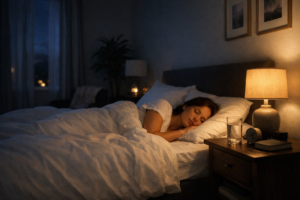
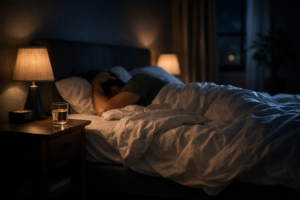
It is 11:47 PM. I am lying in the dark, and without any warning whatsoever, my brain decides it is the perfect time to replay a mildly embarrassing thing I said at a work lunch in 2011. Then it fast-forwards to tomorrow’s meeting, circles back to a text I never answered, and somehow ends up catastrophizing about a decision I have not even made yet. Sound familiar? If you have ever experienced racing thoughts at bedtime anxiety, you already know that the moment your body finally gets still, your mind throws a full-blown party — and you were not invited to be the calm guest.
For six months, I treated my sleepless brain like a research project. I read the studies, tried the supplements, changed my routines, and honestly embarrassed myself in front of my partner with some of the stranger techniques. Here is what I learned — and what actually worked.

Why Your Brain Suddenly Gets Loud the Moment You Lie Down
There is a real neurological reason this happens, and it is not because you are broken. During the day, your prefrontal cortex — the part of your brain responsible for executive function and decision-making — is busy managing tasks, conversations, and sensory input. That busyness acts as a kind of noise-canceling filter for anxious thoughts. The moment you remove all that stimulation at bedtime, your default mode network kicks in. This is the brain’s internal narrative system, and in anxious people, it tends to run loud.
A 2019 review published in Sleep Medicine Reviews confirmed that people with high trait anxiety show significantly more pre-sleep cognitive arousal than low-anxiety individuals. In plain language: your nervous system has not gotten the memo that the day is over. It is still scanning for threats, rehearsing conversations, and running worst-case-scenario simulations — all while you are desperately trying to sleep.
Understanding this was genuinely helpful for me. My nighttime spiral was not a character flaw. It was a nervous system wired for vigilance that had not learned how to safely power down. That reframe gave me permission to approach the problem practically rather than just lying there feeling guilty about being awake.
The Environment Fixes That Made an Immediate Difference
Before I even touched supplements or mental techniques, I overhauled my bedroom environment. This was the fastest win I found, and I wish someone had told me to start here.
When Your Racing Thoughts Need Competing Input: White Noise as a Cognitive Redirect
One of the most effective (and underrated) ways to interrupt bedtime rumination is to give your brain something predictable to listen to instead. Racing thoughts thrive in silence—they fill the void. A quality white noise machine doesn’t sedate you; it gently redirects your attention away from the thought loop and toward a neutral auditory anchor.
What works
- It occupies the auditory channel your anxiety uses to replay conversations and worries, making it harder for catastrophic thoughts to command full attention.
- The consistency and lack of narrative in white noise (unlike music or podcasts) makes it easier to mentally habituate to—it becomes background rather than engaging, which is exactly what you want at 11:47 PM.
- It creates a reliable sleep ritual and sensory boundary that signals to your nervous system that the workday thinking is now off-limits—this repetition builds real sleep conditioning over weeks.
What doesn’t
- White noise is a coping tool, not a cure; if your racing thoughts are rooted in unmanaged stress, anxiety disorder, or unresolved daytime conflicts, the machine will help you *sleep through* the symptom but won’t resolve what’s driving it.
- Some people (especially those sensitive to tinnitus or certain sound frequencies) find white noise agitating rather than soothing—and that’s real, not a failure on your part.
I hesitate to recommend any gadget as a standalone solution to insomnia—I’ve watched people rely on them as a way to avoid the harder cognitive work of managing daytime anxiety—but when used *alongside* therapy or sleep hygiene practices, a reliable machine like the Dreamegg Sound Machine D1 Nova can be genuinely helpful for breaking the silence-feeds-anxiety cycle.
About This Article

Written by Sarah Mitchell. Sarah Mitchell isn't a therapist. She got interested in how the mind works after her own struggle with anxiety in her twenties, and has spent 16 years since then reading and personally testing cognitive behavioural therapy (CBT), acceptance and commitment therapy (ACT), and attachment-based approaches. Her writing combines that research with genuine compassion for how hard mental health struggles actually are. More about this site.
Scope and limits. Sarah is not a licensed therapist or clinician, and nothing here is a substitute for care. If you are in crisis or thinking about harming yourself, call or text 988 in the US to reach the Suicide & Crisis Lifeline.
Verify this against a primary source
Specifics change, and your situation may differ from the one described here. These are the authorities worth checking directly:
- NIMH — mental health research and condition information
- SAMHSA — treatment locator and the 988 Suicide & Crisis Lifeline
- American Psychological Association — evidence-based practice guidance